
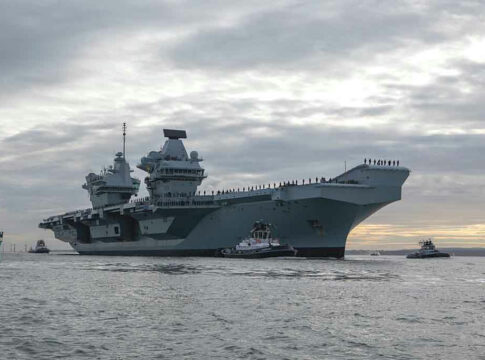
China is building carriers at a pace that looks impressive on paper, but the real test is whether it can protect them at sea.
Quick Take
- China now operates three aircraft carriers and aims for nine by 2035.[1]
- U.S. assessments say the carrier plan depends on far more escorts, submarines, and support ships.[8]
- Chinese shipbuilding is a major strength, but small logistics fleets can still become a weak spot.[2][8]
- Carrier power is not just about hulls. It also needs training, fuel, escort ships, and combat experience.[3][6]
China’s Carrier Push Is Moving Faster Than Its Support Fleet
The Pentagon now says the People’s Liberation Army Navy plans to build six more carriers by 2035, which would bring China’s total to nine.[1] That is a huge leap from a navy that had no fixed-wing carrier force only a short time ago. The speed of the buildup has caught attention because carrier strength is not measured by deck space alone. It depends on the ships that defend, fuel, and sustain the carrier group.
China’s carrier fleet is still young. The Liaoning entered service in 2012, the Shandong followed in 2019, and the Fujian was commissioned in 2025.[3][12] The Fujian is the most advanced of the three and uses electromagnetic catapult technology, which gives China a more modern launch system.[10] Even so, several sources note that China still lacks the long carrier experience the United States has built over decades.[3][10]
Escorts, Replenishment Ships, and Submarines Remain the Hard Part
Carrier groups are fragile without a strong screen around them. A Naval War College study on China’s carrier ambitions said escort capability implies destroyers, frigates, and supply ships, and estimated one carrier battle group could cost about ten billion dollars.[17] Another analysis said the People’s Liberation Army Navy’s replenishment capacity remains concentrated in a surprisingly small number of ships, with only two Type 901 fast replenishment ships in the key support role.[8] That is a real constraint for any navy trying to keep several carriers at sea.
Support capacity matters even more because China wants to operate outside coastal waters. Research from the Air University said China still cannot conduct carrier flight operations far from emergency divert airfields, and that better underway replenishment and foreign port access would help but still may not be enough for long operations beyond East Asia.[5][6] That warning fits the broader concern: a carrier without fuel, escorts, and maintenance support is a symbol, not a fully credible combat tool.
Big Shipbuilding Power Does Not Solve Every Naval Problem
China’s industrial base is a major advantage. One cited analysis says Chinese shipyards have far more capacity than their American counterparts, and that gap helps explain why Beijing can move so quickly on new hulls.[2] But building ships fast is only part of the equation. Analysts also note that carrier operations require trained crews, mature doctrine, and a logistics system that can keep strike groups moving under pressure.[10][16] Those are harder to copy than steel production.
SCMP's piece https://t.co/0MDrs2zITI on PLA scientists openly publishing a “how to kill US carrier strike groups from 3,000km away” playbook is wild for two reason: it tells you who’s confident in their own backyard, and who’s relying on nostalgia and aircraft‑carrier Hollywood… pic.twitter.com/wmBIWDC5Kg
— StarBoySAR 🇭🇰 🇨🇳 🥭 (@StarboySAR) June 18, 2026
The historical record supports that caution. China’s first carrier, the Liaoning, was described by ChinaPower as better suited for regional missions such as training, humanitarian aid, and showing the flag, rather than high-intensity conflict.[6] A separate United States Naval Institute study said future Chinese carrier strike groups would rely on a growing mix of destroyers and frigates, but it still tied real power projection to a much larger supporting fleet.[11] In plain terms, the hull count can rise faster than combat credibility.
What This Means for U.S. Readers
For American readers, the issue is not just China’s carrier count. It is whether Beijing can turn those ships into a true blue-water force that can challenge U.S. and allied navies far from home.[2][11] The sources here point to a mixed picture. China has real momentum, serious shipbuilding depth, and a growing carrier program. But the evidence also shows a navy still working through escort shortages, replenishment limits, and the hard lessons of carrier warfare at sea.
Sources:
[1] Web – China Is Building Aircraft Carriers Faster Than Anyone Since WWII — …
[2] Web – China Wants Nine Aircraft Carriers by 2035, Says New Pentagon …
[3] Web – China’s Shipbuilding Capacity is 232 Times Greater Than That of the …
[5] YouTube – Why China’s Carriers are Still 20 Years Behind America
[6] Web – Aircraft carrier – Wikipedia
[8] Web – Chinese aircraft-carriers will soon outnumber American … – Instagram
[10] Web – China Plans 9 Aircraft Carriers by 2035. The U.S. Navy Has 11
[11] YouTube – China is making big aircraft carrier moves. Here’s how its …
[12] Web – Strike Groups with Chinese Characteristics – U.S. Naval Institute
[16] Web – China sends new navy fleet on Gulf of Aden escort mission http …
[17] Web – The Role of Aircraft Carriers in a Contested Age