
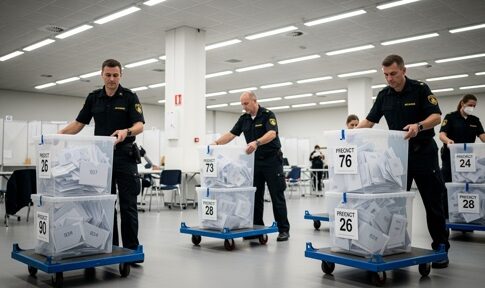
A postal union’s push for more mail voting is colliding with a familiar conservative worry: rules that expand convenience while shrinking confidence and accountability.
What the documentation shows—and what it doesn’t
Available research does not confirm a singular, newly launched “ad campaign” by a Postal Service union aimed at rebutting President Trump in real time. Instead, the record points to continuing union advocacy such as the American Postal Workers Union’s “Vote By Mail 101” resource and the National Postal Mail Handlers Union’s election-readiness messaging leading into 2024. The distinction matters because a media headline can suggest a fresh escalation, while the underlying materials read more like persistent, long-running persuasion.
That gap between the premise and the documentation is important for readers trying to sort signal from noise. Conservative voters who watched election rules change rapidly in 2020 tend to demand specifics: who funded messaging, where it ran, and what it asked voters to do. In the sources provided here, the best-supported facts center on USPS election operations and union statements about mail voting’s reliability, not a clearly evidenced, newly announced paid media campaign.
How USPS says Election Mail is identified, tracked, and prioritized
USPS describes Election Mail as a defined mail category with recommended practices designed to help election officials and postal employees identify ballots quickly. USPS guidance highlights specialized tags and identifiers, including red Tag 57 and green Tag 191, plus Intelligent Mail barcodes and service type identifiers used to improve visibility and processing. The agency also emphasizes coordination with election officials and operational planning intended to move ballots through the system with high priority.
USPS materials also show the agency leaning heavily on process standardization and advance coordination rather than political messaging. For the 2024 cycle, USPS distributed an “Election Mail Kit” to thousands of election boards and indicated it would deploy “ballot monitors” beginning October 1 as part of seasonal readiness. Those steps reflect a bureaucratic approach: educate election offices on correct mail design and entry procedures, then watch for bottlenecks as volume rises.
What unions argue: history, volume, and a “working people” message
Postal unions frame vote-by-mail as both historic and practical. APWU’s materials trace absentee voting back to the Civil War and stress that USPS has delivered election-related mail for more than a century. Union messaging also points to scale: tens of millions of voters used mail ballots in modern cycles, and USPS processed an enormous volume of ballots in 2020. The argument is straightforward—large volume plus established procedures equals reliability.
NPMHU messaging echoes that theme while emphasizing turnout and convenience. The union cites a turnout increase in “all-mail” states and encourages voters to use resources like vote.org to register and plan. For conservatives, the policy question is not whether USPS can physically transport paper; it is whether states implement uniform verification and custody rules that keep elections transparent and contestable in court if disputes arise. The provided sources focus on delivery mechanics more than state-level verification.
Why the political dispute persists under a second Trump term
President Trump has long criticized mail voting, especially after the 2020 cycle, and the broader conservative movement remains wary of election systems that expand with uneven safeguards. The sources in this packet do not supply fresh Trump quotes, but they do reflect the same clash of priorities: unions and USPS highlight access and operational readiness, while skeptics prioritize chain-of-custody, signature checks, clean voter rolls, and tight deadlines. Those are mostly state-run controls, not USPS functions.
Postal Service union launches ad campaign promoting mail voting as Trump assails the methodhttps://t.co/lrlSMt6dAW
— 7News Boston WHDH (@7News) April 14, 2026
Because USPS is a federal entity, conservatives also watch for any appearance—real or perceived—of federal involvement that edges into election administration, which the Constitution largely leaves to states. The USPS materials presented here emphasize nonpartisanship and process, not advocacy for a particular party. Still, when unions promote mail voting broadly, the politics are unavoidable: expanding mail voting can increase participation, but it also increases the number of ballots handled outside Election Day precincts, where transparency debates are sharpest.
Sources:
https://apwu.org/vote-by-mail-101/
https://about.usps.com/what/government-services/election-mail/
https://www.npmhu.org/media/update/are-you-ready-for-the-2024-elections
https://about.usps.com/publications/pub632.pdf